

Beyond TSMC: Rethinking Kumamoto’s Role in the AI Economy
What makes a region truly competitive in the age of AI?
For decades, manufacturing capacity was considered the foundation of industrial strength. Today, that is no longer enough.
Competitive advantage increasingly depends on a region’s ability to combine knowledge, innovation, advanced manufacturing, and real-world AI deployment into a self-reinforcing ecosystem.
This is why I believe Kumamoto deserves global attention.
Most discussions about TSMC’s investment focus on semiconductor production, economic impact, or supply-chain resilience. Those are important outcomes—but they represent only the first chapter.
The larger opportunity is to transform Kumamoto from a manufacturing hub into a regional innovation ecosystem where AI, semiconductors, and robotics reinforce one another.
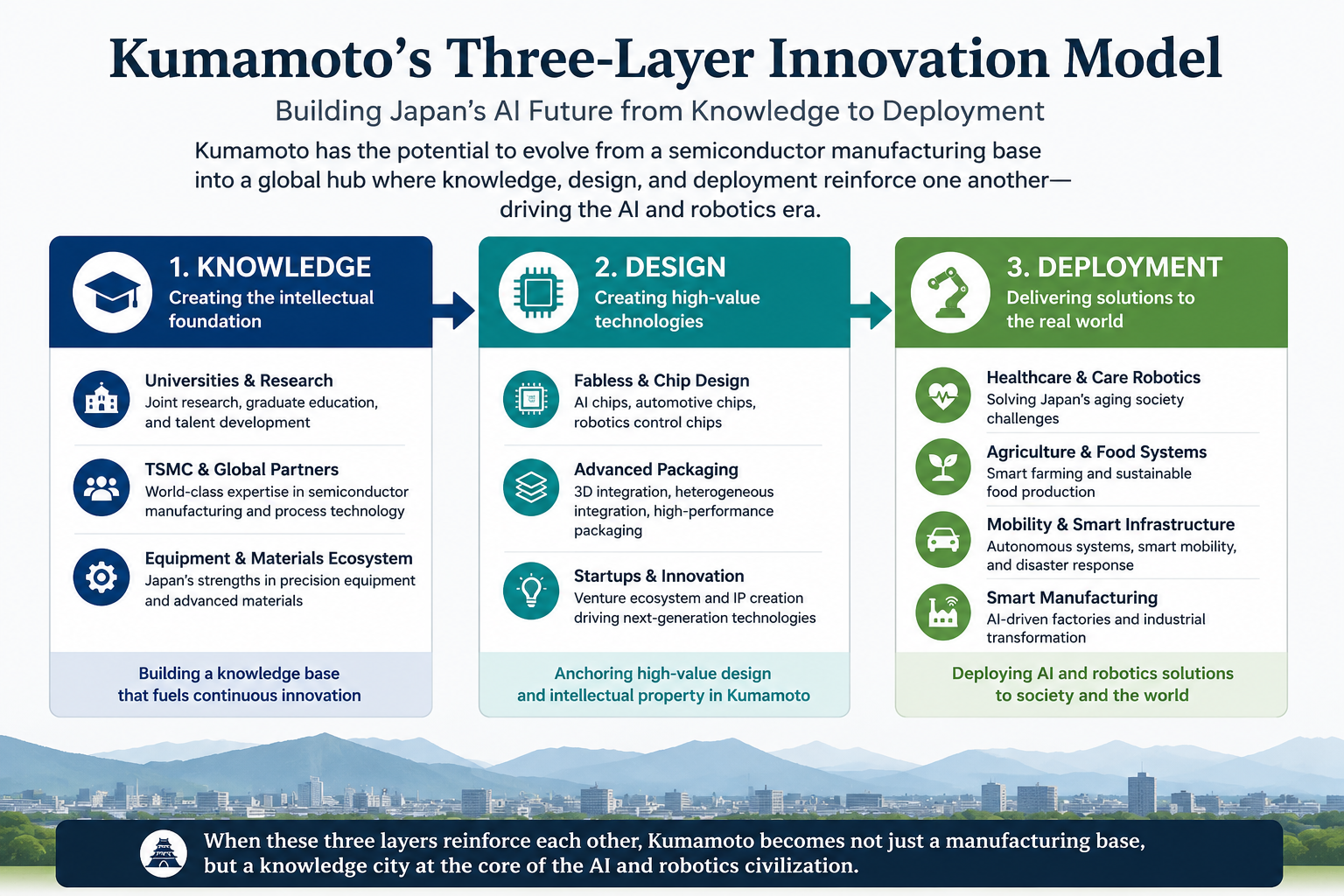
In the article, I propose a simple framework built on three interconnected layers:
• Knowledge — developing research capabilities and world-class talent.
• Design — attracting higher-value semiconductor and AI innovation.
• Deployment — applying AI and robotics to solve real-world challenges in healthcare, manufacturing, agriculture, mobility, and disaster resilience.
Factories create products.
Innovation ecosystems create long-term competitiveness.
TSMC may have opened the door, but Kumamoto’s long-term success will depend on what it builds beyond manufacturing.
I explore why this matters—not only for Kumamoto, but for Japan’s future role in the global AI economy.
Read the full article on Medium:
https://medium.com/@kimura2020/beyond-tsmc-rethinking-kumamotos-role-in-the-ai-economy-1b5a830ee29c?sharedUserId=kimura2020
コメント