

Beyond Series — Pre-Part 4 / Special Analysis | October 2026
When Economic Efficiency Becomes Strategic Vulnerability
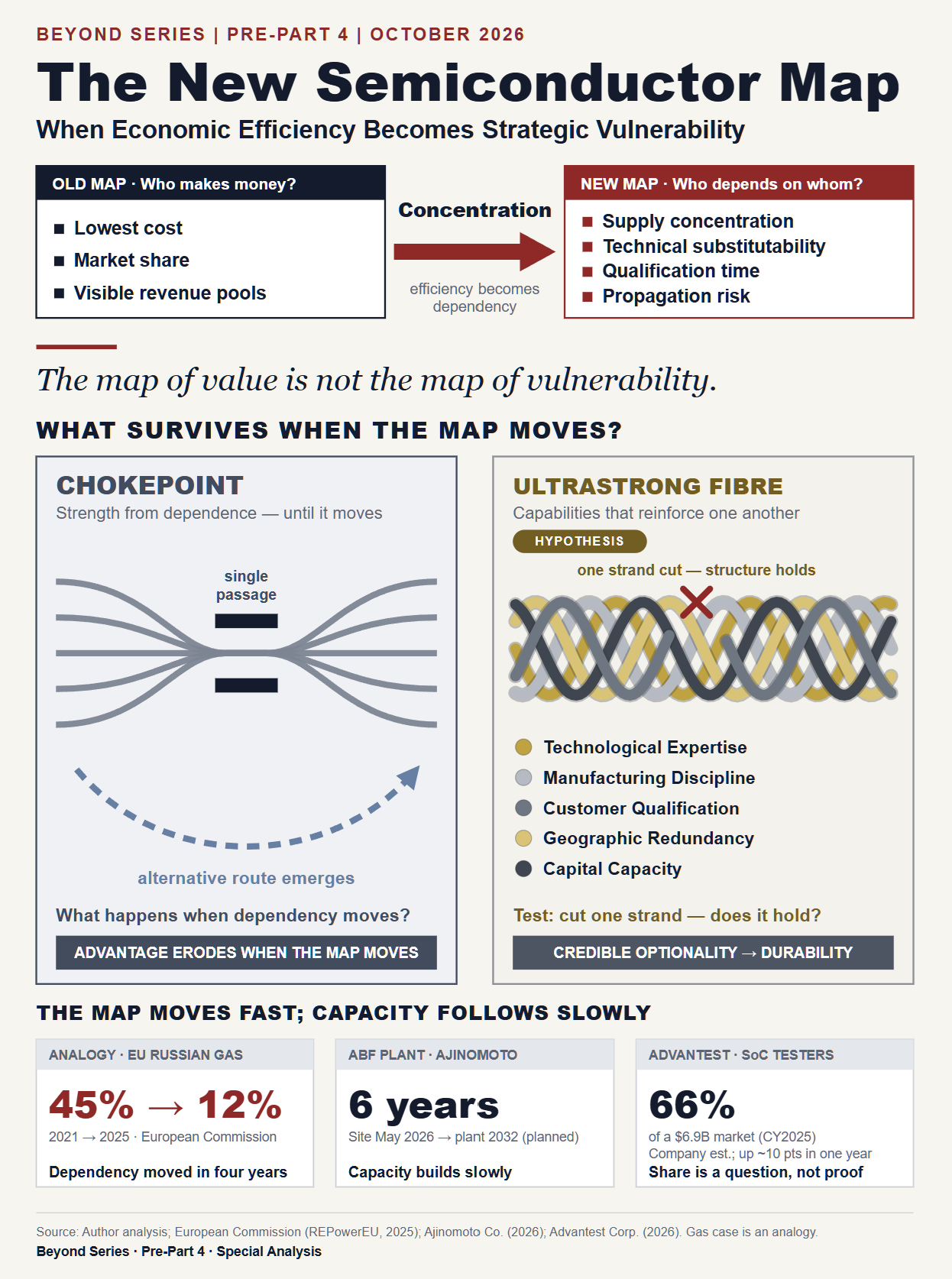
The semiconductor industry was built on an elegant idea: put each capability where it can be produced best, cheapest and at scale. That logic created extraordinary efficiency — and a new class of strategic dependencies. The question now is not simply where the chokepoints are, but which companies can remain difficult to replace when the map itself moves.
Prologue — The Gas Pipeline
Imagine a pipeline that works perfectly. Gas flows west. Money flows east. Contracts are signed, infrastructure is amortised, and both sides have good reasons to keep the system running. For years, Europe and Russia had something close to that arrangement.
Then the meaning of the pipeline changed.
Russia’s invasion of Ukraine in February 2022 transformed an economic dependency into a security problem. The European Commission’s REPowerEU response sought energy savings, diversification and alternatives. The share of Russian gas in EU imports fell from 45% in 2022 to 12% in 2025. The pipes had not suddenly become technically useless. What changed was the strategic value of dependence. [1][2]
That is the first clue.
How can a relationship that was once economically rational become strategically dangerous? The answer is not that economics stopped working. The objective function changed. Price, scale and efficiency were joined by security, optionality and political risk.
The semiconductor industry is now confronting a version of the same puzzle.
The First Clue — Dependency Was the Solution
The semiconductor supply chain was not designed to be fragile. It was designed to be efficient.
Over decades, companies concentrated expertise where scale, yield, capital and customer density created the greatest returns. Leading-edge logic became concentrated. Memory developed specialised clusters. Equipment, materials, packaging and testing evolved into global networks in which a limited number of firms could justify enormous investments in process knowledge, manufacturing consistency and qualification.
This concentration was not a mistake. It was often the economically rational outcome.
That is why the familiar question — “Was globalisation too risky?” — is less interesting than it first appears. Globalisation worked because specialisation worked. The harder question is what happens when the assumptions behind that optimisation change.
A supplier that is merely efficient in normal times can become strategic in a crisis. A factory that looks replaceable on a world map may be irreplaceable for one process node, product or customer. A substitute may exist technically yet remain unusable because qualification takes too long.
The OECD makes the structural problem visible. As of September 2025, China, Taiwan, Korea, Japan and the United States together accounted for 87% of global in-production wafer capacity. More importantly, OECD stresses that fabs are not freely substitutable: process nodes, chip types and technologies impose hard constraints. Concentration can therefore amplify disruption rather than merely reflect efficiency. The figure is a front-end wafer-capacity snapshot, not a complete measure of the semiconductor system; OECD notes that China’s capacity may be understated and that advanced packaging makes front-end-only comparisons increasingly inadequate. [3]
The first part of the mystery is now clear: efficiency created concentration; concentration created dependency. But dependency is not yet leverage. Something else must happen.
When Dependency Becomes Leverage
Dependency is not automatically dangerous. Complex economies depend on one another every day. Interdependence can lower cost, spread expertise and make cooperation profitable.
Leverage appears when dependency becomes difficult to escape — and when that difficulty can influence behaviour.
This is the critical distinction. The strategic variable is not dependence alone, but dependence multiplied by switching difficulty. A material, inspection system, tester or packaging input becomes strategically important when an alternative cannot be introduced quickly without sacrificing yield, reliability, performance or time.
That produces a more useful diagnostic: supply concentration, technical substitutability, qualification time and propagation risk. Add one final question: who bears the cost if the dependency cannot be replaced?
There is a game-theoretic twist. In a stable commercial environment, both sides may welcome dependence because it supports long-term cooperation. But if sanctions, conflict or political coercion become plausible, the payoff matrix changes. The same relationship can shift from mutually beneficial trade toward bargaining power.
Companies then begin paying for something that rarely appeared on the old procurement spreadsheet: the option to walk away.
This does not imply autarky. Strategic durability is not the elimination of dependency. It is the ability to manage dependency without allowing it to become a single point of failure. The real asset is credible optionality — alternative sources, technical knowledge, qualification capability, information and enough capital and time to act before an option becomes an emergency.
The Map Has Changed
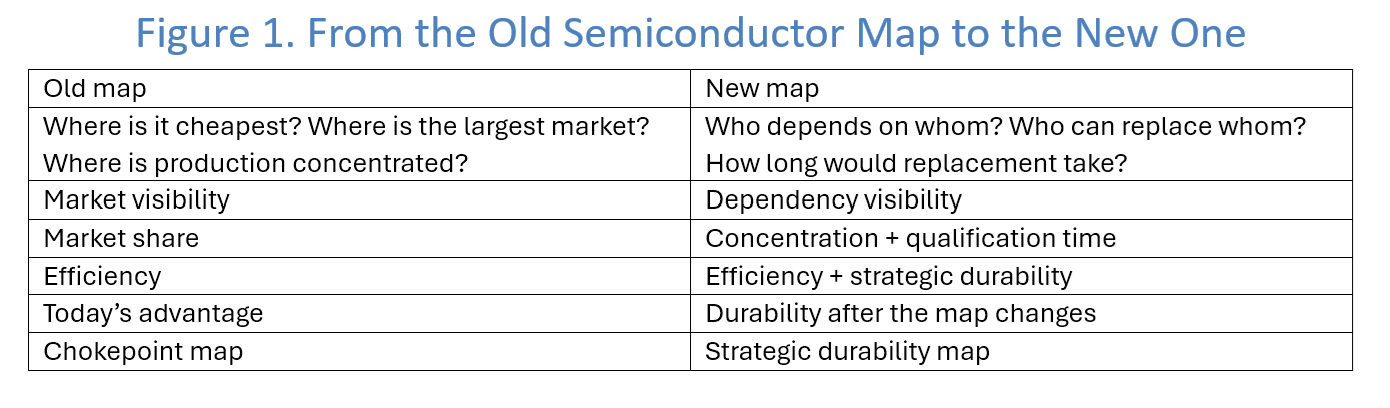
The old semiconductor map can be read through three familiar questions: Where is it cheapest? Where is the largest market? Where is production concentrated?
It highlights NVIDIA, Taiwan Semiconductor Manufacturing Company (TSMC), Samsung, SK hynix, ASML and other firms that dominate visible pools of revenue, market capitalisation or technological attention.
The new map asks three different questions: Who depends on whom? Who can replace whom? How long would replacement take? A fourth stress question follows: what happens if a seemingly small node fails?
The map of value is not the map of vulnerability.
Artificial intelligence (AI) accelerators require leading-edge logic and High Bandwidth Memory (HBM). Those chips increasingly require advanced packaging. The dependency chain then extends through substrates, materials, equipment and process control, and ultimately through power, water, cooling, logistics and skilled labour. A semiconductor system therefore behaves less like a production line and more like a network of dependencies.
That changes the meaning of market strength. A company can have a large market share without being a chokepoint. Another company can operate in a smaller market while sitting on a dependency that is exceptionally hard to replace.
So the new map is not one map. It is a sequence:
Market map → Production map → Dependency map → Leverage map → Strategic durability map
The final map asks the question conventional league tables cannot answer: not where the system is strongest today, but what remains valuable after one of its assumptions breaks.
This is why market share alone can mislead. Revenue records transactions after they happen. Strategic vulnerability is revealed by the cost and time required when the transaction can no longer happen. The crucial variables — qualified capacity elsewhere, qualification time, installed-base dependence and redesign difficulty — often remain invisible until the system is stressed.
The Packaging Clue — Follow the Constraint
Now follow the constraint.
The AI boom did not merely increase demand for leading-edge logic. It increased demand for combinations of logic, HBM and advanced packaging capable of moving enormous quantities of data between components. The constraint therefore propagated outward — from leading-edge logic and HBM to packaging, then to substrates, materials, equipment and process control, with power, water and cooling sitting behind the physical system.
Chip on Wafer on Substrate (CoWoS) remains a TSMC platform; it would be misleading to treat Japanese suppliers as owners of CoWoS. But the surrounding ecosystem offers a useful clue. TSMC’s 2024 supplier awards recognised six companies specifically for advanced-packaging technology collaboration or production support: Asahi Kasei, Canon, DISCO, NAMICS, Shibaura Mechatronics and Scientech. Five were Japanese. [4]
The important fact is not “five Japanese companies.” The important fact is what the list reveals about embeddedness. A supplier can become strategically significant because its technology, process knowledge and production support are woven into another company’s manufacturing system. The awards do not establish market share or prove a chokepoint. They become evidence only when combined with independent evidence about substitutability, qualification and scale.
Then consider Ajinomoto. Ajinomoto Build-up Film (ABF) has been used in semiconductor packaging for decades. In 2026 the company announced a third production site for ABF in Gifu, with construction planned for 2028 and operation for 2032. The company describes the investment as capacity expansion and a Business Continuity Planning (BCP) measure to strengthen stable supply. [5]
The interesting number is not simply 2032. It is the six-year interval from the 2026 announcement to planned operation. That interval is not evidence of an immediate crisis; it is evidence that strategic capacity has a long lead time.
Time belongs on the strategic map. If qualified capacity takes years to build, qualify and integrate, a future shortage cannot be solved by a procurement decision made next quarter. Strategic capacity has a long gestation period. By the time the physical solution arrives, the strategic window may already have closed.

The Japanese Clues — Strong Is Not the Same as Durable
Japan offers another clue, but not the conclusion.
Advantest’s April 27, 2026 materials estimated its CY2025 overall semiconductor tester market share at approximately 65%, with an estimated 66% share in SoC testers. Advantest estimated the CY2025 SoC tester market at approximately $6.9 billion. These are company estimates, not independent market-share measurements. [6]
The analytical question is therefore not “Is 65% a chokepoint?” It is: what makes that share difficult to displace? Qualification requirements? Installed-base dependence? Technology requirements? Customer switching costs? And how quickly could a credible alternative be qualified?
This distinction matters beyond Advantest. The same test applies to equipment, materials, inspection and other specialised suppliers. A large share can be temporary. A smaller share can be durable. The difference lies in what happens when the map changes.
Consider the company as a structure rather than a snapshot. What happens if the current technology advantage disappears? If the easiest production geography becomes constrained? If the largest customer weakens? If the company must finance the next technology before the current one stops generating cash?
These produce four stress tests for strategic durability:
• Technological — Can the company migrate when the architecture changes?
• Geographic — Can it maintain credible production if one location becomes constrained?
• Commercial — Can it remain relevant if its largest customer or market weakens?
• Capital — Can it finance the transition before the old advantage expires?
A durable company should leave traces of those answers in its decisions: capacity added before shortages become acute; geographic separation that creates genuine redundancy; research spending that anticipates the next process or package; and customer relationships strengthened through difficult-to-codify problem solving.
One investment proves little. Repeated investment ahead of structural change is stronger evidence that management is purchasing future optionality — the ability to preserve credible choices when technology, geography or customer structure changes.
And geographic diversification should not be counted mechanically. Two factories in different cities may still share the same electricity market, chemical supplier, logistics route or qualification regime. Real optionality exists only when the failure of one strand does not automatically remove the others.
The Real Question — What Survives When the Map Moves?
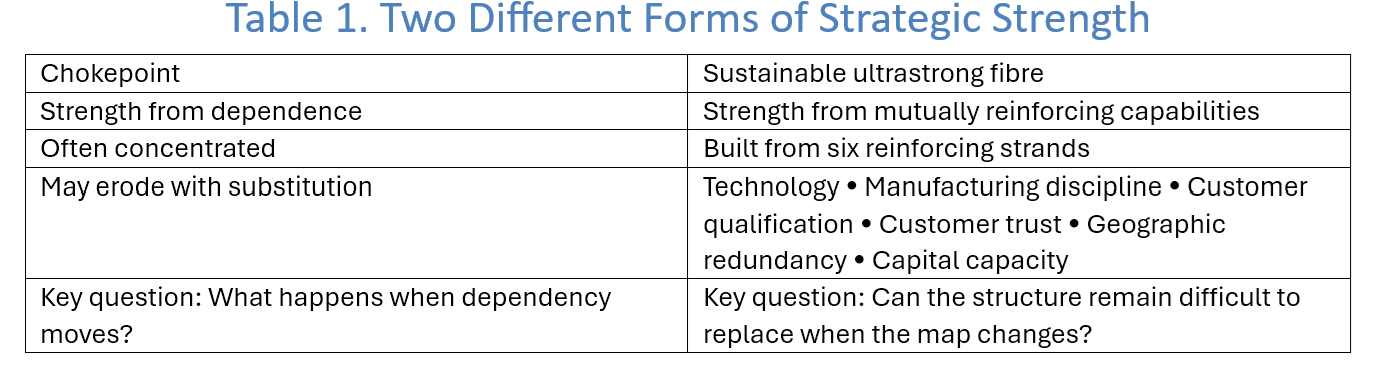
This leads to a more demanding metaphor: the sustainable ultrastrong fibre.
A chokepoint is strong because others depend on it. An ultrastrong fibre is strong because several capabilities reinforce one another — and because those capabilities can be reconfigured when technology, geography or geopolitics changes.
Think of six strands: technological expertise, manufacturing discipline, customer qualification, customer trust, geographic redundancy and capital capacity. Any one may weaken. The question is whether the structure remains strong when one strand is cut. Optionality is not a seventh strand; it is the strategic property that emerges when the six strands reinforce one another.
This also changes the economics of redundancy. The old optimisation problem tried to eliminate slack. The new strategic problem may require some deliberately preserved optionality. That does not mean building excess factories or duplicating every supplier. Redundancy costs money. The relevant calculation is whether the cost of redundancy is lower than the expected cost of interruption.
That is not a slogan. It is capital allocation.
For executives, the question becomes: What is our current chokepoint — and what would destroy it? For investors: What would make today’s moat obsolete, and what evidence shows management is preparing for that moment? For analysts: Where is qualified supply concentrated, how long is the escape route, and which companies have enough independent strands of capability to survive the move?
Epilogue — Beyond the Chokepoint
The semiconductor industry is entering a period in which economic efficiency and strategic durability can no longer be treated as separate objectives.
The old map rewarded specialisation. The new map rewards optionality — the ability to preserve credible choices as the architecture, geography or customer structure changes.
But this does not mean abandoning globalisation or rebuilding every supply chain inside national borders. That would be expensive — and too simple.
The deeper change is subtler. Companies and governments are asking not only where a capability is located, but whether the system can still function if that capability becomes unavailable.
That is the significance of chokepoints. And it is also their limitation.
A chokepoint can move. A technology can be replaced. A customer can redesign. A country can diversify. A new factory can redraw the geography of dependence.
The strategic advantage of tomorrow may therefore belong not to the company controlling today’s narrowest passage, but to the company whose capabilities remain valuable after the passage moves.
That is the proposition behind the next chapter.
Beyond Chokepoints.
And, ultimately, Beyond the Chips.
Terminology note
“Strategic durability” is used here instead of the more familiar “resilience.” Resilience usually asks whether a system can absorb or recover from disruption. Strategic durability asks a broader corporate question: can a company remain difficult to replace after the source of its advantage, technology architecture, geographic configuration or geopolitical map changes? The term is proposed as an analytical concept for this series, not as an established academic taxonomy.
Sources and Notes
[1] European Commission, REPowerEU — EU response to Russia’s invasion of Ukraine, energy diversification and reduction of Russian fossil-fuel dependence. https://managenergy.ec.europa.eu/publications/repowereu_en
[2] European Commission, REPowerEU — 4 years on. Russian gas share fell from 45% of EU gas imports in 2021 to 12% in 2025; Russian gas imports declined from 152 bcm in 2021 to 36 bcm in 2025. https://energy.ec.europa.eu/strategy/repowereu-phase-out-russian-energy-imports/repowereu-4-years_en
[3] OECD (2025), “The chip landscape: Geographical distribution of wafer fabrication capacity”, OECD Science, Technology and Industry Policy Papers, №188, 1 December 2025. Five economies — China, Chinese Taipei (Taiwan), Korea, Japan and the United States — accounted for 87% of global in-production wafer capacity as of September 2025. OECD cautions that China’s capacity may be understated and that advanced packaging makes front-end-only comparisons increasingly inadequate. https://doi.org/10.1787/02dbd028-en
[4] TSMC, 2024 Supply Chain Management Forum, 2 December 2024. Six suppliers received awards specifically for advanced-packaging technology collaboration or production support: Asahi Kasei, Canon, DISCO, NAMICS, Shibaura Mechatronics and Scientech; five were Japanese. The award list is not a market-share measure. https://pr.tsmc.com/schinese/news/3192
[5] Ajinomoto, 7 May 2026. New ABF production site in Gifu; construction planned for 2028 and operation for 2032; the company describes the third production base as a capacity-expansion and BCP measure. https://www.ajinomoto.com/cms_wp_ajnmt_global/wp-content/uploads/pdf/2026_05_07_02E.pdf
[6] Advantest Corporation, FY2025 (Period Ended March 31, 2026), materials dated 27 April 2026. Company-estimated CY2025 overall tester market share approximately 65%; SoC tester share 66%; CY2025 SoC tester market approximately US$6.9 billion. https://www.advantest.com/document/en/investors/ir-library/result/JE_BIZ_260427_note.pdf
Evidence discipline
Company market-share figures are identified as company estimates. TSMC supplier awards are treated as evidence of collaboration and production support, not market share. The OECD 87% figure is explicitly a front-end wafer-capacity snapshot and is subject to the data limitations described by OECD. The Russia-Europe case is used as a structural analogy, not as a claim that semiconductor supply chains and energy systems are identical. The “ultrastrong fibre” concept is an analytical hypothesis requiring further testing.
Author Disclosure
The author has an ongoing research and business interest in mapping the Kyushu semiconductor ecosystem through the Kyushu Semiconductor Observatory (KSO). This article does not treat KSO as evidence for its claims; regional examples are based on public sources, and the proposed “ultrastrong fibre” framework is presented independently as a hypothesis for further analysis.
コメント